Shumei Yachiyo University School
About two miles from Chiba New Town in a wooded environment lies the entrance to a Shumei Yachiyo University School. Our bus follows the winding dirt road to a wide parking area fronted by a Shinto bell tower, beyond which lies a soccer field. It is early morning. The sun is directly in our eyes and casts long shadows that fall toward us with dramatic length. The air, still moist with dew, begins to fill with a crystalline mist. The atmosphere adds an aura to all people and objects that recalls Japanese landscape painting. Young people are disembarking from busses that pull into the parking area one at a time. Although everyone is in uniform, I can sense a striving individual flair in the way that students choose accessories, wear scarves or cinch their neckties.
A few students, mostly girls are already milling about the front of the pitch carrying instruments. Soon more bustle about and a group of boys carry out a set of two large Tyco drums. In a few minutes the formal presentation begins. No sooner are we introduced as distinguished American educators visiting for the day then the band breaks into song: fine renditions of hits by Earth Wind and Fire and the soundtrack of Saturday Night Fever. It seems that all the students who are not performing are looking out their windows onto the courtyard. We learn that the bell tower is a place where upon starting school at Shumei Yachiyo, students are asked to make a record of their academic ambitions and place them inside. I ponder this ritual as my colleagues and I back at Manchester Craftsmen’s Guild have recently started to pilot a student goal setting instrument in out after school arts programs. I wonder if we can add some aspect of ritual to this process with the result of making the effort more meaningful and engaging for students.
As in the U.S., Japan has both private and public schools. What is different is that in Japan compulsory education only goes up too 15 years of age. Despite this all but 2% of Japanese students attend and graduate from high school. Shoshei, one of the country’s many private high schools actually accommodates 1450 students from middle school through high school age. Parents pay the equivalent of about $3600 per year to send their children to Shoshei, but it is important to remember that because, high school education is not compulsory, even public high schools require a tuition payment in the range of $1,600 per year. Shumei Yachiyo has several intriguing facets. Student admission is based on an interview that focuses on student aspirations and interpersonal qualities rather than a scholastic achievement test. Another critical feature of Shoshei is the fact that it is modeled on an English school. All students wear a uniform that includes British looking blazers, neckties, and skirts with knee socks for girls.
As we begin to walk about the school grounds we can see that this institution is committed to a model of education that aims to marry best practices of two distinct traditions. We learn that there are 11 native English speakers on faculty and that all students spend a month in Great Britain as part of the school’s core curriculum. Making our way to the gymnasium, we are treated to two demonstrations of martial arts: karate and a form of stick fighting called kendo. The karate demonstrator, we learn, is a regional champion. Throughout the school’s hallways we see many photographs of students on playing fields and on the grounds of what I imagine to be a school in England. In all the images they are active and smiling with other students and faculty. What I look for but do not see are many examples of student work on public view. We continue to move through the second of the school’s three buildings where we are led to an indoor onsen, a steamy room for bathing in the tradition of Japanese culture.
I visit a course that is being led by Ms. Marion Lynch, one of the native English speaking faculty members. The conversation is about favorite foods and how to describe their flavors. Students seem to grasp the meaning of the English words though they seem hesitant to respond orally, perhaps due to the visitors in the room. Ms. Lynch is a dynamic teacher and she presses on. Her students’ return her energy and effort with their full attention throughout the lesson. Eventually few verbal responses are forthcoming. We soon return to our meeting room where students meet to accompany us to lunch. Unlike other Japanese schools Shumei Yachiyo maintains a cafeteria where students eat lunch by grade level as is common in US schools. From what I can see, all students eat the school prepared lunch with little or no complaint. The food is ample, well prepared and nutritious. A short time later, we return once again to our meeting room and are soon collected by a group of students who escort us to the school’s third building.
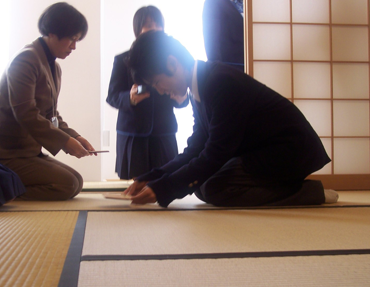
Upon entry we now find ourselves in a different world reminiscent of Japan’s Edo period. We remove our shoes and proceed in stocking feet across a hallway lined with tatami mats. From this hallway we are separated into groups of ten or so and led to separate rooms divided by sliding paper walls. I feel as though I have entered a Ukiyo-e print. We learn that at Shumei Yachiyo, study and practice of the Tea Ceremony is a requirement of all students… both male and female. The “way of tea” or cha-no yu is a foundational construct of traditional Japanese society and an important value of Shoshei School. The tea ceremony dates to the early 1600s when philosopher statesman, Sen-no Rikyu developed a practice to ritualize observation of aesthetic meditation as a means of cultivating ethical and moral aspects desired in the Samurai class. These warriors were meant to hold to a strict code of mental, emotional and physical discipline that was embodied within the tea ceremony (chado or sado). The full-length, ritualized preparation and serving of powdered green tea in the presence of esteemed guests involves a meal (chakaiseki) and two servings of tea (koicha and usucha) and lasts approximately four hours. During this time the host is meant to engage his whole being in the creation of an occasion designed to bring aesthetic, intellectual and physical enjoyment, and peace of mind to the guests. Our experience at Shoshei Yachiyo begins with a sweet bean cake. We are told that the sweet is meant to offer a palliative counterpoint to the green tea that may seem bitter to our under-initiated tastes. This tea ceremony can best be described as a demonstration project with accompanying informative narrative. The entire ceremony lasts about forty minutes.
A sensei dressed in traditional kimono is introduced as the students’ tea master. At the school she provides regular tutorials to train students in executing the way of tea. To achieve this status, the sensei or hostess may spend decades mastering not only the measured procedures for serving tea in front of guests, but also learning to appreciate art, crafts, poetry and calligraphy; and learning to arrange flowers, cook and care for a garden; at the same time instilling in himself or herself grace, selflessness and attentiveness to the needs of others.
One young woman knelt before a ceramic brazier into which a steaming bronze kettle was nestled. She used a slender length of bamboo with a curve at one end to carefully scoop a small mound of powdered green tea from a ceramic vessel and deposited it into a tea bowl. Into this she slowly poured hot water and then briskly agitated the solution with a bamboo whisk until the mixture was frothy on top with air bubbles. Tea was prepared one cup at a time and additional students place each cup before a guest, positioned on the floor around the perimeter of the room. The tea bowl is placed on one side of a black border connecting separate tatami mats. The server bows from a kneeling position after placing the tea bowl before his guest. The guest bows in turn before reaching across the seam to gather the tea bowl in two hands. He admires the bowl and rotates it twice in a clockwise direction to admire its beauty before sipping from the rim. All these movements and many more are choreographed in a form of classical dance composed of pedestrian movements.
Although the hosts direct their efforts towards the enjoyment of the participants the ceremony nonetheless humbles us. It is the first of our school visits and we are still feeling overwhelmed with our role as guests. Part of this stems from the fact that in the US, educators are rarely treated with such respect. We are also beginning to see the first of our embedded cultural differences. In Japan, being a host is a kind of art form with a highly developed aesthetic and interpersonal sensibilities. While we Westerners are thought of as outgoing and gregarious, there are few rules that hold hard and fast from one region of our country to the other.
We return to our meeting room for a conversation with faculty about what we have seen. The native English-speaking faculty members sit in the front row on the opposite side of the room from us, and their Japanese colleagues sit behind them. The formal structure of this arrangement does little to encourage a free flow of dialog. Several questions about issues we have been exposed to during the first days of our JFMF seminars in Tokyo—the presence and effects of bullying, teachers outlook on the new educational policies—are left dangling without clear response. Still, Shumei Yachiyo has offered a surprising initiation to the workings of a Japanese school. The fact that the school enables students to transition from Junior High to High School within the same institution would seem to offer a healthy alternative to the competitive stress of placing into an academically rigorous secondary school education. It may not be indicative of what most students have the opportunity to experience, but it is heartening to find liberal educational values mingling with traditional Japanese culture. The school is highly organized and both students and faculty seem to enjoy being with one another and learning together.

japan journal
Tuesday, November 21, 2006