Journey to Mashiko
Mashiko is a small town in Tochigi prefecture. It is located 25 km from Utsunomiya-city and is close to Nikko The journey from Tokyo requires about 2.5 travel hours to the north and west. There are nearly 400 pottery studios and kilns in Mashiko. Many of the local kilns and stores offer hand made ceramics for sale. The pottery making tradtion of Mashiko dates back several hundred years and in recent times it is best known as the home and workplace of Shoji Hamada. Hamada’s relationships with potters Kanjiro Kawai, Bernard Leach and writer Soetsu Yanagi make him a pivotal figure in the revival of Mingei culture and the studio pottery movement as global phenomena.
The visit to Mashiko was a high point of my Japan Fulbright Memorial Fund program thanks to old friends who stepped in to help my cause. In addition to introductions from potter Gregory Miller a former colleague at Manchester Craftsmen’s Guild, I was fortunate to have Shuske Namura, the young brother-in-law of MCG alumnus Max Perelman as my guide. I also had the engaging company of three other Japan Fulbright Memorial fellows who joined me, art teachers Bradley McMurray (Florida) and Monica Winters (Texas) and Albert Cho a history teacher from Boston.
Shusuke is 25 years old and I could tell from our e-mail exchanges in the days leading up to the trip that he was already keeping the long hours of a good company man. He works on project management for a team that is designing English study software for a popular game system. This seems like a shrewd business strategy as his company is taking advantage of what the government claims to be an alarming amount of time students spend in front of video games rather than studying or participating in physical exercise. Though not a pottery fan, Shusuke is gracious in agreeing to help us on this journey and spending the entirety of what must be a very precious day off.
With Shusuke's help the journey to Mashiko was a memorable experience. Savvy Japanese commuters are constantly updating on information about possible train routes and departure times via cell phone based Internet connections and Shusuke was no novice. He managed to make alterations to our route that afforded us the opportunity to ride trains from the 19th, 20th and 21st Centuries. Discovering that the circa 1887 steam engine was running the tracks to Mashiko was a real coup. The train, which runs only on an occasional basis, was a magnet for children and families who fantasize about old time railroading just as kids and hobbyists do in the US.
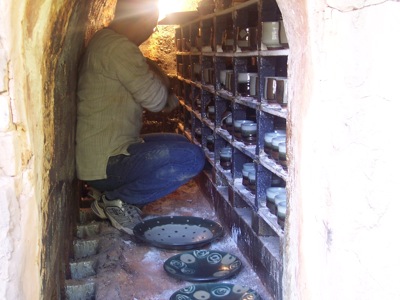
Once in Mashiko, Shusuke helped us find the Hamada estate where we wandered the grounds and admired kilns, studio and gardens. After a short time, thanks to Greg Miller’s introductions to Shoji Hamada's grandsons, we were soon met by Takuji who walked the grounds with us discussing the legacy of his grandfather. Soon he walked us a few houses down the road to see Tomoo. As luck would have it we got to witness the unloading of the just fired noborigama kiln that was filled with thousands of pots.
With just enough time to enjoy a soba lunch at a small restaurant
across the street from the estate in the late afternoon, we began the
walk back to town stopping in several galleries. At one, we
all purchased tea bowls and underestimated the amount of time this
process would take here in Japan. The wrapping itself was another art form to admire. Unfortunately, by the time this was completed it was already dark and the old kiln, Daiseigama was not accessible to us. We spent another hour or so in galleries and the indigo dying house before boarding the last bus from Mashiko to Utsenomia where we eventually boarded a train back to Tokyo.

japan journal
Saturday, November 18, 2006