Inzai City Kioroshi Elementary School
Inzai City's most traditional homes have small plots with potted plants in their yards. At the top of a hill up one narrow street lined with such domiciles we come upon Kioroshi Elementary School. Founded in 1874, this is the oldest school in the prefecture and from the first moments in the building we can see that there is great pride in this legacy. Photos of the schools past principals line the wall of Kawashima-Sensei’s office. She is the school’s twenty-ninth leader and we ask her in jest when her picture will join the others. She is an ideal embodiment of the school’s institutional memory. She uses hand gestures as though she were building a village in the space before us. She communicates with enthusiasm about her love for children and their community, energy practically flying from her fingertips. She explains that her school maintains five chefs and a nutritionist to prepare healthy meals for all children in the school’s own kitchen.
We are led into a gymnasium and greeted by the entire student body with rousing applause. Children step forward to microphones to lead the ceremony. Japanese speakers go first and other children reading translations into English follow them. Then the students give us the gift of song. The choral and instrumental pieces have student conductors. We exit the gymnasium to additional clapping and waving and begin our walk about the remainder of the building.
Returning first to the principal’s office, a group of six parents soon appears: two fathers and four mothers. It is now past 9 a.m. and it is clear from their dress that some of them have already come from work. They are members of the PTA and express their gratitude for and interest in our visit. They share with us their feelings about the importance of maintaining connection with their children’s school and being involved in their education in general. We learn that several of them will be able to meet with us at Inzai City’s Cultural Hall on Thursday afternoon, which is a Shinto festival day. Once they depart, we note that many works of calligraphy hang in frames on the walls. Some of these express the school goals. There is a set that enumerates goals for teachers and staff, another for students. Teachers strive to foster children that are bright and polite; able to think for them selves and study voluntarily; have warm hearts, and are healthy and persistent. Goals for children are to greet everyone; study hard; read frequently; make friends; exercise and learn. Kawashima-Sensei informs us that she also has a goal for her school: namely that faculty and children have pride in it.
Complementing a pride in history is the school’s pride in place. Nearby is a nationally protected a geologic strata containing fossils of the undersea life that inhabited this landscapes some 300,000 years ago. We climb the stairs too the roof where we can look out across the Tone River. To the North we can just barely make out Mount Tsukuba and to the West on a clear day, Fuji-san can also come into view.
Walking through the school’s hallways pride in tradition is also expressed through many forms of culture. Children’s artworks hang nearby reproductions of impressionist paintings. The student drawings are figurative and expressive. They show young artists wrestling with the problems of foreshortening and perspective, qualities I do not often expect to find in work by students of this age. Most surprising though are the many Ikebana arrangements that adorn tables and shelves on two separate floors of the school. I learn these have just been completed as an outcome of a special experience with a visiting Ikebana master. Kawashima-Sensei shares with me that her flower arrangement is the one that greeted us as we entered the school. It involves a massive bundle of russet and yellow flowers that are pouring out of a large wicker basket placed beside a water wheel. I learn that she is a member of the Sogetsu School and share with her that I have friends that my wife studies with in Pittsburgh who are also members of this society.
Three hundred and sixty students attend Kioroshi School. It has special programs for intellectually and emotionally challenged children. I join a class known as integrated studies. This is a period that is often devoted to team teaching that often involves social studies and mathematics. Today with a group of 4th graders, I am learning to make bookmarks by gluing maple leafs onto strips of paper. Desks are arranged into small work groups and children face one another in groups of five or six. An energetic young man who I later learn is a new teacher is leading the class. He has an engaging way with the students and tolerates moderate levels of excitement and conversation among the groups. When he does need to get their attention, he steps forward approaching the middle of the room and covers his mouth with his hands, speaking through them as though they provide both a muffle and a megaphone. Technique is effective as he continues to deliver direction. My team works individually to glue our leafs onto paper and together we place five to six of these strips between sheets of plastic laminate. One team member from each group takes sheets from their tables to the laminating machine while others wait patiently at the table. Our team leader soon returns with our sheet and instructs us how to trim the laminate to make individual bookmarks. He takes extra time with me demonstrating how to round the corners so that someone won’t get poked with a hard point of plastic. Once this is done, we use a punch to create a hole through which a length of ribbon is passed and tied off. By the end of the class everyone has created at least two bookmarks.
Next I join a calligraphy course taught by Vice Principal, Akihiro Hiyoshi. We first follow a pre-printed diagram to learn the proper order and direction of the brush strokes. Before we apply ink we simply shadow Hiyoshi-Sensei’s movements using a dry brush. I learn that this Kanji composed of two characters that stand side-by-side means autumn. Through the shadowing exercise I come to appreciate that the painting of Kanji with Sumie ink and brush involves alternating rhythms of pressure, release and direction: left to right, right to left, down-up. The brush strokes begin with a slight twisting motion before proceeding to the end of the lie where pressure is gradually released. I find this much more difficult than II had initially anticipated. After practicing on two pre-printed diagrams I try may hand on blank sheets of rice paper. I see that children are beginning to line up at the front of the class so the sensei can inspect their work. He uses red inked stamp and brush to make marks on each student’ effort. On some he circles specific characters or uses his red wash to re-define where the edge of the brush stroke should be. On a few pages he traces an energetic line that spirals from the outer edges of the page to the center. This seems to be in cases where the graphic arrangements of lines are nearly correct. I feel rewarded when one of my sheets earns a sweeping, red spiral.
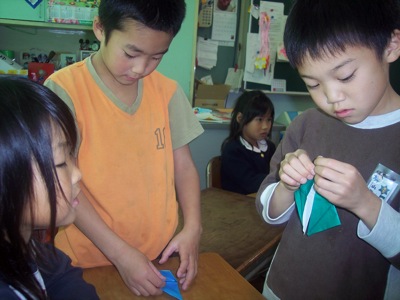
As I leave the classroom children are scurrying through the hallways with lunch carts. Soon I hear a child’s voice over the school-wide speaker system announcing that lunch will soon be served. Two boys escort me to join their 2nd year classmates in their room for lunch. The food is already laid out on trays when I am shown to my seat. Lunch includes a nutritious and flavorful miso soup richly stocked with chunks of tofu and greens. There is also a homemade stew, seaweed salad, bean cake and milk. The children all seem to enjoy the food though I notice that several students are avoiding the salad just as they might avoid vegetables back in the states. I am impressed when a few of the smallest boys in the class take their bowls back over to the large pot and serve themselves another bowl of miso. Following lunch all of the students take their plates up to a cart outside the classroom door and carefully clean their plates, scraping and sorting different food scraps into distinct receptacles. Once this is done, bowls cups are rinsed and ready to be cleaned elsewhere. Once food and dishes are cleared from the classroom a few children begin to hand out origami paper. One boy at my table clearly has a special skill and he assists me with the process of creating a paper crane. Once mine is complete, he circulates around the table assisting other classmates.
The music change over the loudspeakers now indicates that it is time for school cleaning. Children take up mops, brooms, dustpans and rags and go directly to task. I can hardly believe my eyes, thinking how difficult it can be back home to have even much older students take care of their own workspace in the art studio. Here it seems to go seamlessly and with little to no obvious adult direction. I am beginning to tease a theme or lesson out of the day. It is that Kioroshi has found a way to place students in leadership positions in a vast array of school functions. I wonder why in US schools we assume that the environment will completely break down without adults in control. The very notion of a school in the US without minute-to-minute adult supervision even sounds scary as I write about it. And, yet, here before my eyes I am seeing things that make me reconsider this basic assumption.
In the afternoon I join an English class that is team led. A visiting Californian introduces himself simply as Trout. Another teacher of Japanese origin joins him to co-lead the class. The lesson is on naming fruits and vegetables. First the teachers establish a basic understanding of the names of fruits and vegetables with children responding individually and through group recitation. Next we all practice asking questions and giving responses about our favorite fruits and vegetables. Finally Trout passes out worksheets with a table to record classmates’ responses as to their favorites. Students begin to circulate around the room and break off in pairs for short conversations and busy notation. After about five minutes, Trout calls time and we move back to our seats. A recap of responses ensues and Trout keeps tab of what fruits and vegetables have earned the most frequent responses. A simple interview process has been the framework for a conversational English class that worked on so many levels. Students had fun while they were learning basic vocabulary. They got to move around the classroom and have social engagements with a number of peers and they had to manage their time in accordance with the task. The summation of responses even modeled they way one might look for trends in marketing or other workplace contexts.
At the conclusion of the day, we set aside time to meet with Kioroshi teachers. We are all very tired. We learn that many of us face similar challenges related to children at our own schools. There are concerns about curriculum, helping students who need extra attention and managing behavior. Still, the environment at Kioroshi is one that any US teacher would admire for its degree of student leadership and cooperation.

japan journal
Wednesday, November 22, 2006