Tsujiki: Tokyo Fish Market
I rise at 3:45 a.m. and find the shower in a haze of dreams. Fifteen minutes later, I am in the hotel lobby where a half dozen of my colleagues are already milling about. What has gotten us all up so early is Tsujiki, also known as the Tokyo Fish Market. The subways won’t begin running for another hour so we somehow begin to form into groups of four to share cab rides to the market. I fall into a group with Robin, Kathleen and Linda, teachers from Wyoming, Michigan and Connecticut. We reach the market by 4:40 or so. The street side of the market is lined with noodle stands, tiny coffee and sushi shops that are just beginning to open. We walk to the corner and look to our left to see a network of alleys already buzzing with trucks and one-man vehicles that are a cross between a pick-up truck and a motorcycle. They have a single wheel up front to make tight turns and a headlight that blazes into the darkness to illuminate the pavement before them. I will have to wake up in a hurry if I don’t want to wander into the path and be run down by one of these mechanical Cyclopes, or worse yet by one of the tarpaulin covered trucks. A warren of warehouses and large opened wall malls flanks the interconnecting alleys. They are already full of activity.
We wander around the harried workers as they move, unload and design the display of the vast array of sea life bound for restaurant and home kitchens or neighborhood markets. Periodically we ask for direction to the tuna auction and are waved in a particular direction with a hand gesture and a burst of Japanese that I cannot understand. We try to keep moving in the general direction of where we believe the auction to be but there is too much visual stimulation and we keep pulling out our cameras. Stalls in each of the mall structures are about ten feet by twenty feet and jammed tightly with stacked rectangular Styrofoam shipping boxes. At the front of each stall, these packages are arranged into waist high Lego-like columns to form pedestals for the display of the open container that rests atop. Some of these are full of water. Lengths of clear plastic tubing run from a pump buried somewhere within the stall through which air is constantly pumped causing bubbles form on the water’s surface. Peer through them and you will find dozens of fish still swimming and flopping around. There are too many varieties to name and remember. Some are familiar but many I am seeing for the first time. One of these is full of a sluggish, fleshy looking fish about eight inches in length. It is covered in a smooth mottled gray skin and reminds me of a catfish. A friendly market worker approaches and informs me that I am admiring Fugu, the Japanese blowfish that is prized by sushi chefs and feared by tentative Western epicures who have read about the fact that it is poisonous. A potentially deadly dining experience if you are served by the less than knowledgeable Sushi chef who may not know that the female of the species and her roe can be lethal.
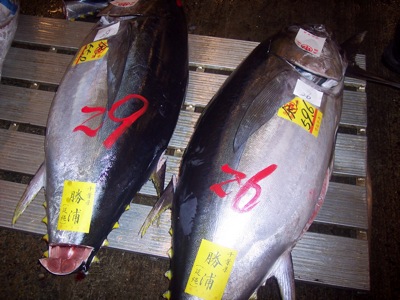
With my new friend’s help, we finally find our way to the warehouse where the tuna auction will begin at 5:30 a.m. There are large overhead garage doors already partially open and we can see the massive tuna carcasses arranged on pallets that rest in rows across the length of the building. We can see dozens of men already milling about inspecting the tail ends of the giant fish where a slice has been made halfway through the torso to reveal the color and texture of the meat. The doors to this building are clearly marked with signs admonishing that only authorized visitors are permitted. Those inside before the auction begins are jobbers—authorized buyers for markets and restaurants throughout the Tokyo region. They will make their selections and stand before the fish they want when the auctioneer rings his bell to commence the sale.
Each tuna bears a number painted in deep red food coloring. As soon as the hand-bell clangs, the jobbers who have been keenly appraising the goods gather round. The auctioneer chants out the number and price of tuna with rhythmic intonation. In response, jobbers indicate their bids with small gestures. The gesticulations begin among several bidders all at once, but soon there are only two men making small movements cutting the air with the pinky side of their hands in front of their chests. In a few seconds the sale of each fish is over and the auctioneer continues to move down the row, with jobbers in tow. The auction goes on for about an hour and every fish is sold… perhaps 120 or more. Almost immediately large flatbed hand trucks that look something like wheelbarrows appear. Massive fish are grabbed with grappling hooks and dragged to the end of the pallet row where they are then loaded on hand trucks. In another ten minutes the warehouse is empty of both people and fish.
Even as the day is just turning light, I recognize the morning at Tsujiki as a pivotal moment in my still brief time in Tokyo. Experiencing the auction and the people that work in the stalls surrounding it provide an opportunity for insight into how people do business and the degree to which Japan’s culture is inseparable from the bountiful harvest of the world’s seas. If when we think of America, we envision grain, prairie and cattle, now when I think of Japan, I will see a small island surrounded by massive seas. This will not however evoke a vast space of isolation amid water, but an endless if tenuous connection to life and nourishment. While the harvest of food from the seas may seem vast in scale, the quantity and quality of the seafood harvest is not something that can be taken for granted in the 21st Century. According to a study published in the journal Science by Boris Worm of Canada’s Dalhousie University, ocean ecosystems are in trouble and losing species fast, which could leave no seafood to harvest before 2050 if the current global trend continues. "This loss of species is threatening the sustainability of not only fishing, but … also other human uses of the ocean," said Worm. A recent survey of global fisheries data says that seafood stocks around the world will collapse within 50 years if we don't change the way we treat the world's oceans. "That's the end of the line." Such an event would be catastrophic the world over, but the impact would be felt in Japan well in advance of other parts of the world where the national culture, economy and diet are not so closely tied to the sea.
This future is far too much to contemplate so early in the morning. It is also not going away. For the moment I determine to appreciate what I have just before me: a Haiku for the morning’s end.
Steaming Ramen bowl
served from a stand. Eating
with Chopsticks at dawn.

japan journal
Friday, November 17, 2006